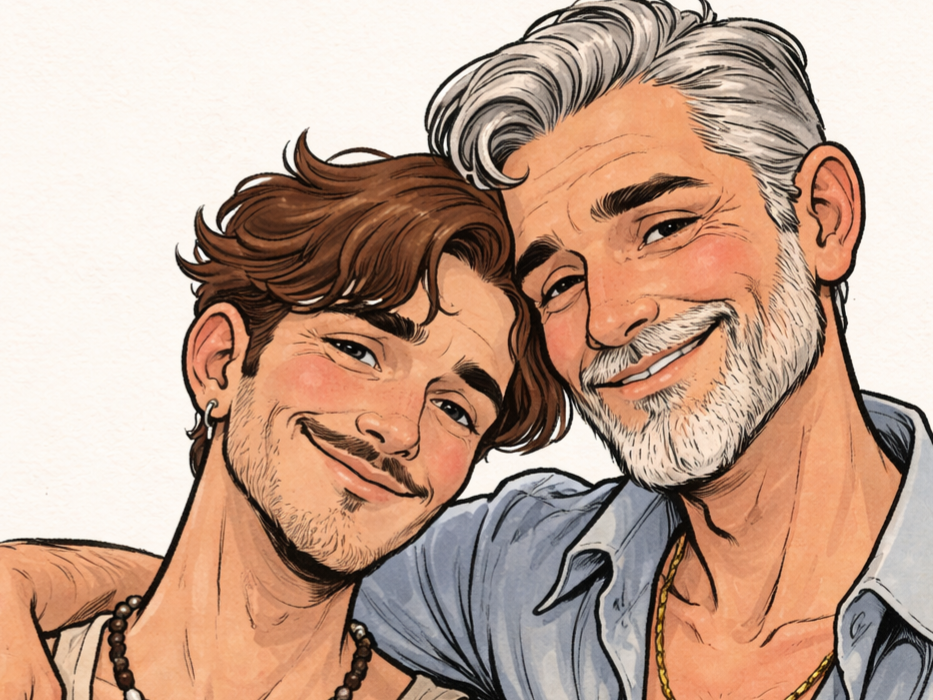
It is a beautiful Wednesday in December, the last day of 2025. The sun finally breaks through after days of relentless rain and thunderstorms. The year feels exhausted, ready to collapse, yet the shifting of identity and the evolution of intimacy remain relentless in society. Before the new year arrives, it feels necessary to pause and examine one of the most persistent, highlighted, and emotionally charged dynamics within South Africa’s gay community: age-gap relationships.
Reports of domestic violence within age-gap romances circulate with disturbing regularity. Stories of younger partners chased out of homes in the middle of the night; slapped, struck with bottles, threatened with sharp objects, emotionally terrorised, or exposed to social disease. Yet, step outside into restaurants, shopping malls, social events, or even scroll through the newsfeed, and another image dominates: young and older men holding hands, kissing in parking lots, presenting affection as certainty. This contradiction is not accidental. It is structural, emotional, and massively social.
Unlike many parts of Africa where homosexuality remains criminalised — punishable by heavy fines including imprisonment of up to ten years, as seen in countries like Uganda, South Africa occupies a unique position. It became the first African nation to legalise same-sex unions under the Civil Union Act of 2006. While the early years were marked by discrimination and moral panic, the country has, over time, adopted a reluctant tolerance that allows individuals to live, if not always safely, then at least legally under the law, even with personal differences.
Within this space of relative freedom, complex relational patterns have flourished. Among them, age-gap relationships remain particularly charged.
The Language of Age-Gap Desire
“He Is 19. He Is 63.” Older Partner or Sugar Daddy?
As Morrell and his contemporaries define it, a sugar daddy is a man with a non-marital partner at least ten years younger, where money, gifts, or access are exchanged for sex. The foundation is transactional, entrenched in economic power and sexual availability.
An older intimate partner, by contrast, is someone a younger man chooses based on attraction, emotional resonance, or shared desire. Such relationships may be short-lived or enduring. One-night stands and hookups fall into the category of short-term intimacy, where emotional and financial support are neither expected nor sustained.
Both dynamics involve younger and older men. The distinction lies not in age, but in intention. Transactional versus intentional. Survival versus desire. Access versus attachment.
The Emotional Economy of Rejection
Dating within the gay community is rarely as effortless as it appears. For many men, it is exhausting — shaped by age, race, gender expression, class, and geography. Younger gay men are often dismissed as “too gay,” while older gay men are rendered invisible by the same community that once demanded visibility from society.
This creates an uneven emotional economy where younger and older men, rejected by their peers, find solace in one another. Ironically, the support and tenderness gay men seek from society are often denied to one another. Emotional wounds circulate within the community, disguised as preference, humour, or pure cruelty.
There exists a particular language, not of desire, but of damage.
“I only date Black guys because they have big penises. I only date older white men because they can afford me”
This is not preference; it is reduction. In this framing, the Black man is no longer human but anatomical, and the white man is the finance house. A relationship cannot be built on genital mythology or financial expectations. What appears as sexual/financial preference is often a wound-seeking occupation. Such patterns demand self-interrogation: Why this fixation? Where did it originate? What absence is it trying to replace?
Until these questions are asked honestly, the cycle repeats — and age-gap relationships become safe containers for unresolved pain and the country’s economic struggles.
Desire in the Age of Projection
We live in a postmodern world where language reshapes desire. Terms like Daddy and Zaddy dominate social spaces, transforming power, age, and authority into aesthetic fantasies. Behaviours once unthinkable in pre-industrial or early industrial societies are now normalised through digital culture, pornography, and social media.
A young gay man begins to imagine himself inside these fantasies — not necessarily because he desires domination, but because he wants belonging. He wants visibility. He wants to feel current, desired, and chosen. The fantasy becomes a passport into relevance.
The Cost of Security
Gay men are often drawn to the glamorous, polished, and picturesque lifestyle of Sir Elton John. Why? That is a topic for another day. In cities like Johannesburg, Cape Town, and Durban, older men with homes, careers, cars, and social capital appear as stability itself. Youth, in turn, becomes a form of currency to access the elite lifestyle.
There is nothing inherently wrong with wanting security, unless security becomes the foundation of intimacy.
Power imbalances emerge when one partner controls access to housing, finances, or social networks. Some relationships are genuine matches: a young man admires what an older man has built and is independently working toward similar goals. Others are rooted in inadequacy, where youth is exchanged for survival.
In South Africa, where youth poverty remains structurally entrenched, age-gap relationships often operate less as romance and more as a non-communicated economic negotiation.
Preference vs. Wound?
I like his confidence and maturity. He matches my lifestyle. (Preference)
I like him because he controls things. I cannot lead. (Emotional wound)
I’m not sure I love him, but who else will love me? I’ll probably die by myself if I ever leave him. (Emotional wound)
I date him because he validates me. For the first time in my life, there is a man who shows up for me, telling me all the good things about myself, and what I do well. (Emotional wound)
Preference is shaped by joy, alignment, and values. An emotional wound is tied to filling the void, seeking to replace former rejection, humiliation, abandonment, lack and traumatic experiences, not connection. Preferences evolve with growth; wounds remain static, repeating themselves through different faces, bodies, and dates. Preferences expand life, wounds recreate pain.
What We Were Never Taught
Across much of our beloved Africa, a gay man commonly grows up without mirrors, mentors, or safe spaces to explore and express his identity. His environment forces him to suppress and shrink himself, often told to behave like a man, be a man, speak like a man, and act like a man. As a result, he tends towards secrecy and perhaps relies on explicit sources to learn about himself. Often, through distorted digital sources rather than the loving human guidance of a parent.
Older men sometimes appear as mentors, offering knowledge, safety, and validation to a young, desperate gay man. Yet not all mentors are benevolent. Some are predators cloaked in guidance. The absence of father figures leaves young men searching for instruction that leads them into the lion’s den.
This signals why the father figure is important in every boy’s life, regardless of sexuality. To teach him about the realities of today’s society. To teach him independence, not dependency; self-worth, not submission; autonomy, not survival through another man, but most importantly, to make sure that boy does not need another man to teach him things a father should have taught him.
Still, it would be dishonest to frame all age-gap relationships as detrimental. The same way, same-age relationships are. Some are grounded in respect, tenderness, and mutual agency. We have all witnessed beautiful love and solid age-gap relationships in our families, from brothers, uncles, friends, fathers and neighbours who are kind and respectful towards one another. Society cannot diagnose intimacy from the outside. Individuals know the foundations of their own relationships better than any observer.
Age-gap relationships within South Africa’s gay community are not inherently broken; the society is. The dysfunctions in these relationships are reflections of a society fractured by inequality, economic disparity and generational absence of fathers in the households. When intimacy is established under conditions of fear, survival and unresolved emotional lack, they risk producing harm that leads to bleeding, and not only in heartbreak, sometimes with consequences that spill into the legal system, healthcare institutions, and ultimate loss of life.
A relationship is not a place to recover what was denied in childhood. When wounds masquerade as preferences, the ending is rarely gentle. What is planted determines what returns. A thorn, regardless of its colour or shape, remains a thorn. The same event will repeat itself until a man has learnt its lesson. That is the law of the universe.
The question is not who you claim to love, but why.
Comments are closed