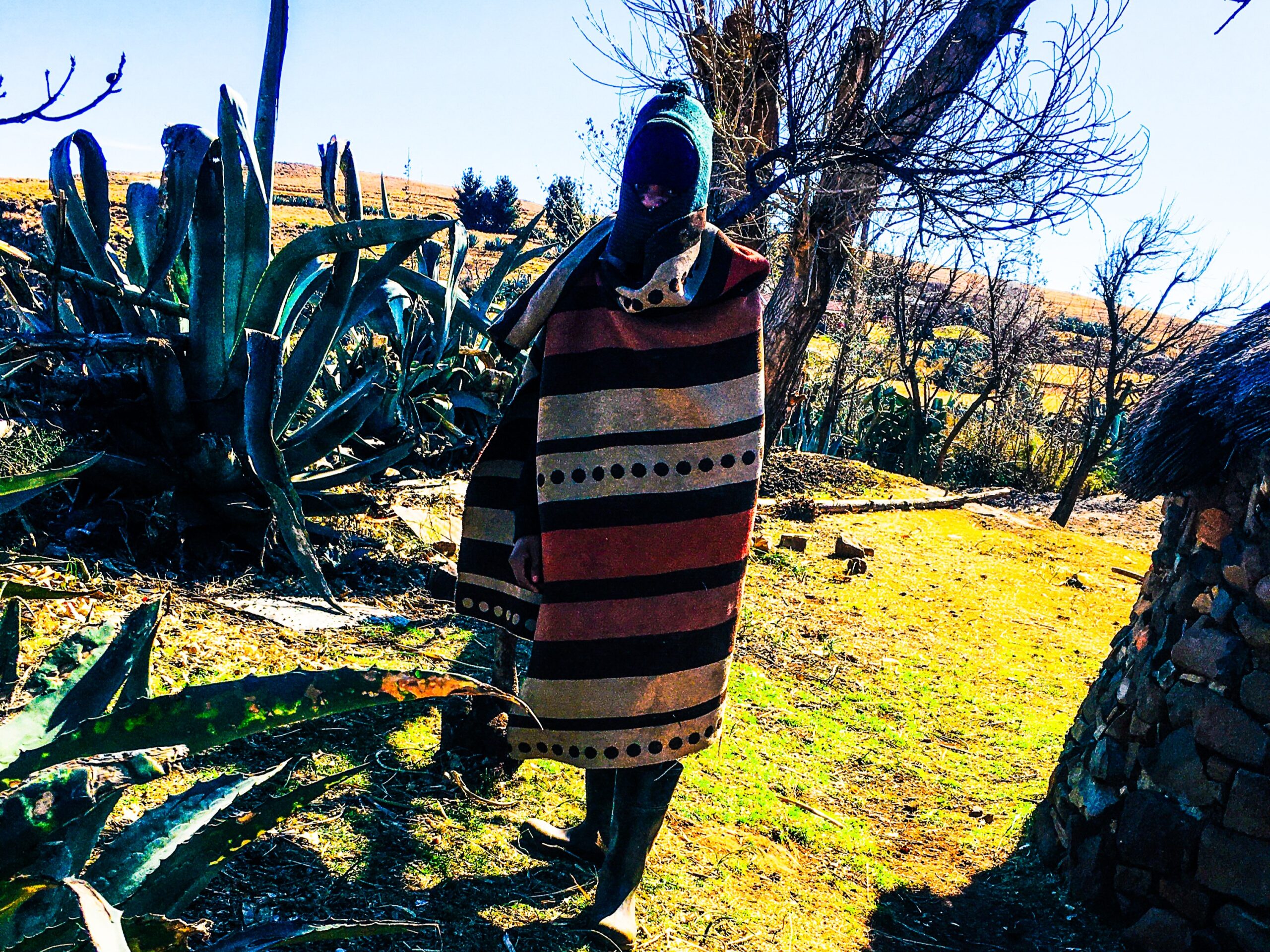
My name is Fusi. The name alone tells a story about me. I came after twins. Had I been born a girl, I would have been called ’Mafusi. Simple as that. Everyone calls me Bushi, a nickname inspired by my complexion. It drove me to the edge at first, though I soon surrendered to it, to this new and inescapable name. Peace was never really an option. There had once been a tired hope that enough whining and protest might make it stop—at least from where I stood.
I was born in a country nobody has heard of, in the district of Qacha’s Nek, in a small village where men plough fields and women tend the household. Every family in the village bears the same surname except for mine and the neighbour’s. My grandmother was born in a distant village some thirty kilometres away, which is where we truly come from. I know little of the neighbour’s origins; I never asked. Children do not ask such things. Answers arise instead from the dusty roads—raw and unsolicited—in a village untouched by progress, breathing woodsmoke and cattle waste, serenaded day and night by the cries of animals.
I am twelve years old, in Grade Six. I started school when I was seven solely because I was born in November. Any child born after June is immediately dismissed as too young, too underdeveloped to begin primary school. Whether this gives a child an advantage or merely wastes another year of life, I cannot tell. There is no preschool here; primary school is the foundation of everything. From my grandmother’s house, I walk for three minutes before turning left onto the laterite road. After an hour and twenty minutes, I arrive at school. It is a red-stone hall of a building whose walls appear ready to collapse at the sound of a throat clearing, and inside, there are no rooms at all. All the children are taught together in that hollow shell. The girls wear maroon pleated uniforms with yellow collars, the boys long khaki trousers and blue shirts, and every head is shaved bright and clean.
I live with my grandmother, whom I love dearly. My parents live in the city. My mother works in Chinese-owned factories, sewing pieces of textile together to make denim shipped to America. They come home once or twice a year, not counting Christmas. My mother; she has beautiful brown skin, glossy brown eyes, a gracious smile and short hair. She met my father when she was sixteen; he was seventeen and working construction, building roads in her village, and I was conceived two years afterwards. My father looks exactly like me. Our cheeks redden in winter. When he speaks to me, there is always a fatherly protectiveness in his voice.
“You should not think of going to initiation school,” he says. Yet he went himself.
He wants me to get an education, find work in government, and one day start a family of my own. Every month-end, they send money home. As the only child, I am spoiled in small ways. My grandmother buys me shoes from Frasers supermarket and sews me jerseys and blankets on her brown Singer machine, stitching together countless colourful scraps of cloth. I was told my twin brothers died only days after they were born.
During the week, I attend school only two or three times, alternating with Lehakoe. His name means precious stone. I envy him for it. Lehakoe sounds infinitely more precious than Fusi. Fusi feels generic, culturally rooted and yet impossible to escape. Lehakoe is several months older than me, which makes him thirteen, though he is still in Grade Four. He has repeated classes throughout the years. Teachers call him the owner of the school, a student born before Horace Mann.
His skin is smooth and dark, the colour of steamed bread spread with dark honey. His teeth are yellow because he never brushes them. His lips are pale and cracked. There is not a single hair on his head. His eyes are blue—not bright blue but a fading blue, washed-out and strange. He is the first and only person I have ever known with eyes like that. He is taller than me and seems destined to outlive everyone our age. His gumboots smell. He never washes his socks. His nails are dirty and unintentionally long. He smells of smoke and sun-baked earth. He smokes hand-rolled cigarettes and dagga, and wears a dark grey blanket at all times.
Recently, Lehakoe announced that he was four-five seconds away from leaving school for initiation.
“School is for soft boys like you,” he said. “I am a man. You’ll see. When I come back, I’ll marry a girl and go work in the mines in South Africa. There’s money there.”
I tell him it is dangerous. Every day, another body returns from the illegal mines in a hearse—boys and young men scarcely older than twenty-five.
“I want to die like a man,” he says.
Something is charming about the way he speaks: foolish, confident and immaculately ignorant.
The village has two common shepherds. One watches the cattle, the other the sheep and goats, with weekends reserved for themselves. They are paid only once a year, usually at the end, when they decide whether to renew their contracts. Almost all of them are illiterate. They come from the highest parts of the country, where horses and donkeys are the only forms of transport. They cannot count animals, time or money. Lehakoe says they make him feel like a university professor from Britain.
My daily routine is simple enough: school one day, herding the next. The teachers despise it. They say I am too bright to waste my future on animals that will not even remember me when I am old. They have held countless meetings with my grandmother, but it is not her fault. Shepherds never stay long. There are stories, too, about strange creatures from the mountains that wander at night. Lehakoe claims his grandmother owns a short man and a monkey and warns me never to repeat it to anyone or she will kill him. My grandmother cannot afford a shepherd on her own.
We are meant to take turns at weekends too, but Lehakoe insists we go together.
“It’s better when you’re there,” he says.
He likes lying on his back in the grass beside me, staring up at the sky we seem close enough to touch. Sometimes he kisses me on the mouth the way a mother kisses a child. Sometimes he shows me his erect penis. It does something to me. At night, I am haunted by feverish dreams of him kissing and touching me as we move through green fields like lovers. I do not know what it is. I have felt this for as long as I can remember, and I have told no one. Not even Lehakoe.
On late autumn days, when the cold begins creeping through the village like a fart through a crowd, we huddle together like sheep until we forget about the animals altogether, only to hear someone shouting in the distance because the cattle have invaded the maize and sorghum fields. We have been punished many times for letting the animals loose, and most people disapprove of us herding together. We become careless rascals, they say.
When there is nothing to eat, we steal maize from the middle of people’s fields where the owners are less likely to notice. We bury it beneath the damp soil for months until the earth has nothing else to offer. Then we dig it up, light a fire and fry it in an old tin. Lehakoe makes kites for us from plastic and wool and sends them sailing into the sky. We play cow chess. It took me a long time to learn the game, but he taught me patiently.
“Protect your cattle while you capture the weaker man’s.”
That was how he explained things.
“When I die, I want to come back as the sun to keep you warm in winter. I’ll leave this old blanket for you.”
He says this often, grinning in a way he tries unsuccessfully to hide. Whenever he does, I feel something dangerous rushing through my body, a feeling both glorious and shameful.
Winter here is monstrously merciless. I wear three blankets beneath a large colourful jacket my grandmother made for me. My cheeks burn red, and my fingers stiffen. Snow swallows my gumboots whole. Rain melts it quickly, unless the winter is dry. Then the snow clings stubbornly to the ground for weeks, and everything simply stops.
I do not miss school when I am with Lehakoe. My teacher, a short middle-aged woman with oiled dark lips, straightened hair and a weak receding hairline, tells me I should not associate with people like him.
“You must separate yourself from that boy,” she says coldly. “You are sweet-natured, and he is vulgar beyond his years.”
But Lehakoe is my best friend. Nobody knows him as I do, and nobody knows me as he does. He bathes me in tenderness, warms me with his cocoa-coloured skin and saves me with his words. When I am with him, I feel that I belong.
Sunday unfolds as always. I brush my teeth and eat breakfast—pap and beans. My grandmother rises early to cook for me before I leave. I shower in the evenings, so I need not waste time in the morning. It feels liberating somehow. I walk out with Lehakoe in high spirits.
“You’re always clean,” he says. “It makes no sense. We spend all day in the wind and the heat from hell, but somehow you still look polished whenever I see that white skin of yours.”
I ignore him and continue driving the animals ahead of us, already resigned to the long day.
“We’re swimming today,” he says, tugging me towards the stream. “Soon it’ll be too cold till summer. Come on.”
We swim beneath the fading autumn sun, leaping from the cliff into the water while our clothes and underwear flutter beside the rocks. My grandmother would kill me if she knew. She insists there are crocodiles in the water. Like my father, she is overprotective, but Lehakoe strips that fear from me. He makes me capable of things I would never otherwise imagine.
Once we burned an entire field because I told him I was hungry. We had tried frying maize in the spring wind, and the fire spread out of control. We ran from the flames, but punishment waited for us at home.
“Days like this make life worth living,” he says now, swimming closer. “I wish it could always be this way. Just me and you.”
Then he kisses me.
His lips are soft and wet as they settle over mine. His hands cradle my face like an infant’s. He kisses me recklessly, fearlessly. I swallow his saliva and feel the world grow still around us. The dam bears witness, though it cannot speak the language of men.
At noon, I lead the animals towards the dam while Lehakoe runs to the edge of the village to fetch the horse for water. He insists horses are powerful, deeply spiritual creatures that require a man like him.
“You want me to see through the horse?” he asks, walking backwards with a grin.
“No one rides that horse,” I warn him.
“I’m going to ride it. Everyone’s frightened of that animal. I’m not talking about women either. There are no men in this village. I’ll show you.”
He is already moving.
“I’ll be back in twenty minutes. Don’t miss me too much, Bushi. And don’t lose the animals.”
While the cattle graze, I watch two birds fighting beside a tree. Their feathers are yellow and grey; one is larger and prettier than the other. They distract me long enough for the animals to finish feeding.
When I begin leading them back towards the grasslands, I notice Lehakoe in the distance. He is running after the horse, shouting. Villagers are running behind him. The horse gallops wildly over the uneven gravel, almost uncontrollable.
“What has he done now?” I mutter.
The horse comes charging in my direction from several kilometres away. Lehakoe and the others fall behind, exhausted.
Eventually, the horse stops. I run towards it, abandoning the animals. There is a body on the ground.
The horse stands over it calmly, chewing grass. The blanket looks familiar.
“Lehakoe.”
My knees buckle.
His face is pressed into the dirt. One arm is tangled in the rope tied to the horse.
I turn him over.
His face is ruined, displaced completely, thick with soil and blood. His body is still warm and strangely soft. The horse has dragged him all the way from the village.
The men arrive panting. They tell me to move aside. One kneels over him.
“He’s dead,” he says.
They untie the rope from his arm, lift him gently and carry him home.
“Take the horse back,” one of the men tells me.
I stare at the animal with fear and hatred. I do not give it water. It does not deserve it.
Then I run back to the animals, dizzy with confusion.
Soon, I see a white van with a red light on its roof cresting the hill towards the village. It blinds the road with flashing colour. I know immediately that it carries Lehakoe’s body, which only moments earlier had been alive and laughing. Nothing makes sense. It feels as though I have wandered into one of those foolish dreams that arrive suddenly and vanish before morning, except this one refuses to end.
That evening, I drive the animals home and sit beside my grandmother in silence. She draws me close and rests my head against her chest. I do not eat. I do not drink. I do not bathe. Night closes around me, but sleep never comes. I remain awake, searching myself for answers to questions too simple to understand.
The next morning I wake earlier than usual. I walk to the neighbour’s kraal and feed the horse its morning salt. Then I pour water into a container. From my pocket, I remove a small bottle and empty its contents into the water. I watch the horse drink every drop. A terrible satisfaction blooms inside me, hollow as a grave. Later I warm water over a wood fire outside, wash myself and leave for school. The morning breeze paints my cheeks red as I climb the lonely hill. Dust settles over my shoes with every step.
I have lost something precious. Lehakoe. Something nobody knew I possessed. A gift given to me before I understood what it was. I have heard about heaven and hell from prophets and evangelists reading from my grandfather’s Bible. If heaven is not a place for people like us, I do not mind. The sun still shines over me. From it, I take warmth and life, and I smile because I imagine you smiling down at me.
Your foolishness. Your tenderness. Your velvet spirit. Your enormous hands. You were glorious. You shone through this forgotten village with humour and heart. Hell will exist only on the day the sun no longer rises.
I speak to the morning sun as though I am lying beside Lehakoe again in the middle of the fields, though in truth I am alone on the road to school.
At night I sit wrapped in a grey blanket, staring across at the neighbour’s yard and wondering: Will I see you again when I die? The thought makes death feel less frightening, almost worth waiting for. For thirty days, I will not cut my hair, trim my nails or change my underwear. I will wash it at night and dry it before morning.
Inside the hut, I tell my grandmother, “Get another shepherd. I can’t do it anymore.” Everything about animals and herding only ever made sense with Lehakoe. Without him, I abandon it completely, searching instead for another life.
Comments are closed