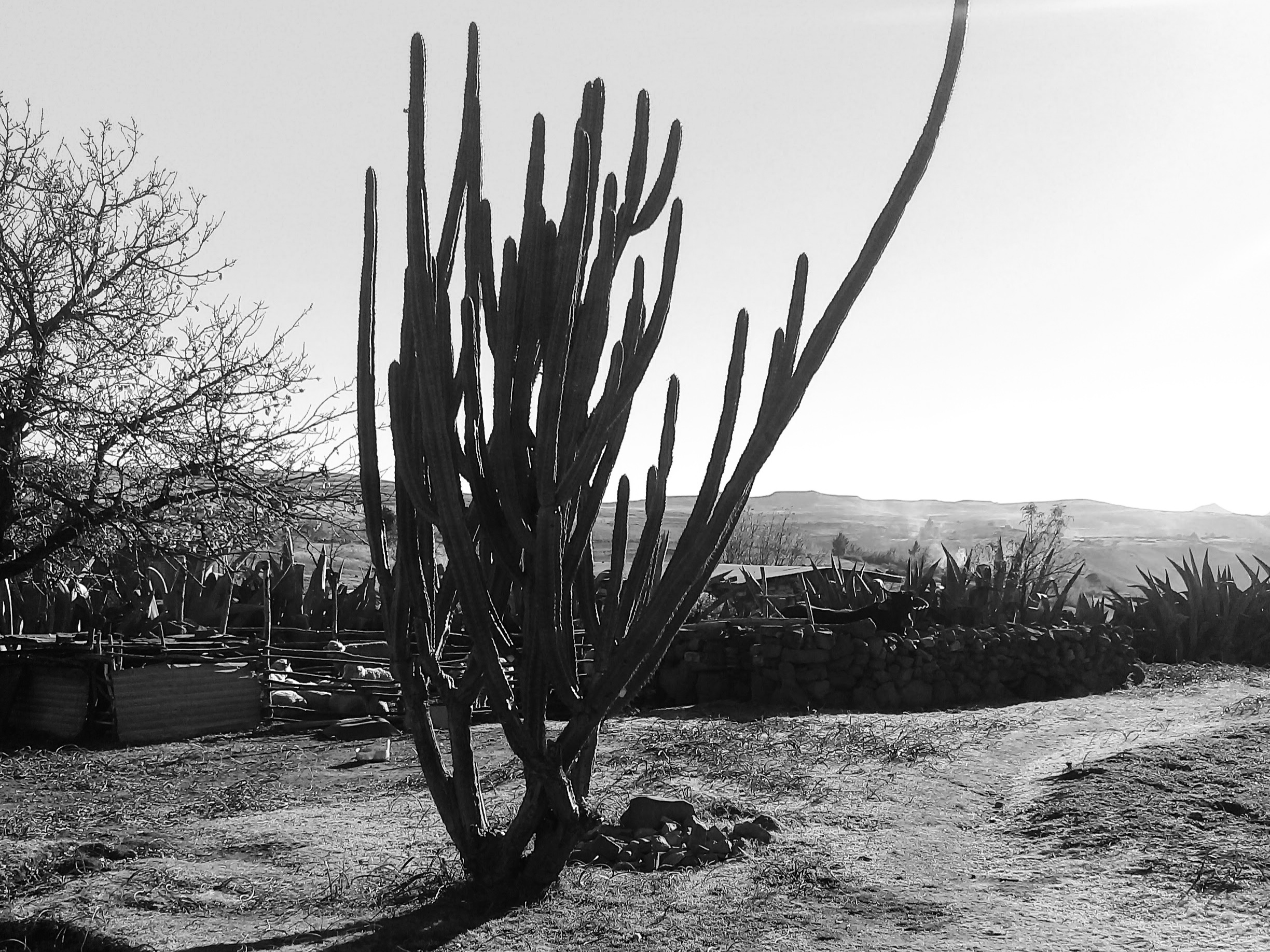
At seventeen, you escaped the braai-coloured village where nothing happened—the only home you had known since your mother gave birth to you. You could not wait to leave it. Men called you “sister”, their voices loaded with ridicule and degradation towards a six-year-old. You escaped the initiation process because you were considered feminine, forever found amongst the girls, playing with hairless, soil-stained dolls belonging to your female acquaintances. You longed for a life entirely different from the one into which you had been born; something unseen, unheard of, but felt within yourself.
When you completed your Lesotho General Certificate of Secondary Education, your father’s sister, who lived in the capital city and worked in government, filled out an application form on your behalf and sent it to the Free State. You laboured tirelessly to deliver your high school transcripts, medical certificate, passport-size photo, relying upon the bus that departed at six in the morning. To catch it, you woke at three and walked for two hours down the mountain in darkness before dawn.
You spent weeks wandering through governmental offices where officials gossiped idly because “the system” was forever down. Although you never surrendered to frustration. You returned repeatedly: first for your passport, then for the evaluation of your results, and finally for your student visa. Your parents sold their fattest cow to finance your transition into this new life. Not once did they complain. On the contrary, they were immensely proud. It was an historic moment for the family. Out of twelve children, one had advanced beyond primary education. All eight daughters were married, while two of the sons remained behind tending animals and labouring on the land.
The day of your departure was bejewelled with the solemnity of an honour. Your mother baked bread upon her Primus stove and slaughtered a heaviest cock for the journey. She folded your clothes neatly into a Scotch paper bag. You threw a stone behind you, cursed the village, and boarded the same bus you had so often watched disappear into the distance. This time, your father accompanied you on horseback.
“Go well, my son,” he said, standing there in his grey blanket, black gumboots and mokorotlo adorned with blue and white beads, while the conductor lifted your paper bag onto the roof of the bus by ladder. As the bus rolled past the familiar valleys and winding paths of your childhood, homesickness seized you almost immediately. Leaving the place you had despised as a child proved far harder than you had imagined. It was meant to feel easy, exciting, liberating. Instead, it felt like bereavement.
Bloemfontein was another world entirely—the most beautiful city upon which your eyes had ever rested. There were tall buildings, residential flats, shopping centres, and, most astonishing of all, people who actually lived in town. Back where you came from, town was merely town: a temporary place for buying Christmas clothes, applying for passports, or seeking governmental services. Nobody remained there after sunset. There were no residential flats, no permanent lives unfolding beneath electric lights. In Bloemfontein, there were towns contained within the town itself.
You settled reasonably well into the institution’s student residence alongside a Xhosa boy named Thulani, the first person ever to introduce you to sex between men.
“It won’t hurt,” he said, focused on your anus.
“Are you sure?” you asked.
“Come on. You should try it. It’s pleasurable.”
He pushed himself inside you, but you told him to stop before anything had truly begun. There was blood, and the pain felt unbearable.
“You’ll get used to it,” he said dismissively. “The more you do it.”
That was his consolation.
“I cannot believe that at seventeen you haven’t had a dick. Ah, gumboots men,” he laughed mockingly.
The following week he took you to a flat in Willows, surrounded by green gardens and guarded at the entrance by security. Inside, two white men waited. They were old—older than your own father.
“Who is your sexy friend?” one of them asked.
“This is my roomie from Lesotho,” Thulani replied.
They handed you a can of Flying Fish and began removing their clothes. This time you were the one inserting the penis, both you and Thulani, into the old white men. You swapped with them until they climaxed. The entire experience felt profoundly traumatic. Kissing them nauseated you. Afterwards, you loathed yourself, though you struggled to place blame entirely upon anyone else. Nobody had forced you. Nobody had told you not to wear a condom either. You had chosen. After that night, you came to resent Thulani and scarcely spoke to him again. Clinic tests consoled you.
It was not long before he moved permanently into that same flat with one of the older men—the owner, an executive at a major food retailer who lived with his mother at his primary residence and reserved the flat lustily for sex.
“You are such a backward bitch,” Thulani told you on the day he left. “It’s not like I forced you into it. I invited you. And it was just sex. It’s not like you’re a woman who can conceive. I saw great potential in you. A handsome boy like you, with that arse and that dick, could build massive wealth for himself if he knew how to resource what he has. How do you think these boys afford Mercedes-Benzes? You think their parents own mines in Gauteng? If you want to remain a gumboots man forever, then so be it.” And with that, he was gone.
Thulani was of caramel complexion, squinted eyes, with a faded blond haircut that sat poorly on his head, and a demonic, red-inked tattoo of a flower right above the divide of his spotted buttocks. He was short and imbued with little real sense of style. Not that you had much yourself, but his white skinny jeans offended you almost as much as his blond hair. You were cautious about what you wore: nothing tight, nothing colourful. You remained traditional, conservative, crudely rural in both bearing and taste.
The man with whom he stayed never ceased calling your phone. His number had long since been blocked, although even after three years, whenever you made a call, his number would appear at the top of your screen, marked only minutes before—like a ghost unwilling to release the living.
You had outperformed every student in the Faculty of Education, majoring in English and Literature, and were awarded a full scholarship to enrol in the Honours Programme. You did not return home—not once, not even for the Christmas holidays. Christmas was a grand celebration in Mount Tabor. Families cooked and baked; they drank, sang, and danced beneath skies swollen with summer heat. Children appeared in new clothes and tasted foods they had never known before. It was a gorgeous season, making all things seem briefly perfect—a sort of fairytale. People travelled from the four corners of the world to reunite with those they loved. Indeed, it was the merry time of the year.
You could not write letters, for your parents were illiterate; therefore, you purchased for them a Nokia 3310 and sent it through the Sprinter, which charged you twenty rand for the service, whilst you yourself used a flipping Motorola.
“I must run to the top of the hill to receive your call. The signal is poor here. Nothing has changed. How are you, my child?” your mother said from the other side of the Mohokare River.
Then, as though announcing the weather, she added: “By the way, your Uncle Sticks has passed away.”
“Everything is fine, Mother,” you replied.
And indeed, everything was fine.
You had enough money to sit under off-white umbrellas at fashionable restaurants and order your favourite Italian pizza. Enough money to wander through the Waterfront Mall and purchase things you did not need—fashion magazines and novels by E. M. Forster. Howards End was the first novel you bought, and it carried you away to a Queen’s England where women wore long thick dresses, hats, and gloves, speaking delicately of journeys to London for important meetings, whilst men attended to business and empire. You felt, whilst reading, that you had lived there before; that you had once walked upon the cold pavements of England and taken tea in Victorian tea-houses with silver spoons and lace curtains. The life you had sought since childhood, in that little smoky village, was not an illusion after all. It existed somewhere in Britain.
You applied for another scholarship and were awarded the opportunity to study in London for two years, pursuing two Master’s programmes, beginning with Literature and the Arts. You visited museums, art galleries, bookshops, libraries, and coffee houses entirely by yourself. Until one Friday evening, whilst dancing to folk music beneath dim amber lights, a stranger tapped your shoulder.
“I am James,” he said charmingly.
He stood tall in front of you with the Godly yet innocent face you had ever seen upon a man. His cheekbones stood proudly, as though sculpted for a painter’s admiration. His teeth were impossibly white—the sort of whiteness you had seen only in snow back home during winter that kept families sleeping with animals in their houses. His breath housed the warm scent of alcohol. His forehead disappeared almost entirely beneath a minimum afro of dark curls.
“My father is Nigerian—Igbo. My mother is from Notting Hill,” he told you some days later, whilst the two of you wandered together shielded under London’s proud skies. And I have a little brother and a sister.
He seemed too dark to be mixed, you thought. His little afro was wholly African; but there was something unusual in the texture of his beard, almost softened and straightened, blending too perfectly to belong entirely to one place. Perhaps, you reasoned, he truly was mixed. But this was not where your curiosity rested. You wished to know the man to the utmost—to understand the hidden architecture of him; whether his buttocks’ stretch marks were covered with hair like his face, whether his stomach curved softly or firmly, whether the hair upon his chest curled like smoke or lay flat against his nipples, whether the stories told of Nigerian men were truth or myth. Desire made a scholar of your imagination.
You gave James more than your body; he gave you only sex. One evening, you surprised him with a newly published novel by a Nigerian author as a gift. He stood guarding the doorway in nothing but boxers.
“My cousin is here,” he said casually.
Inside stood a boy who reminded you instantly of Thulani—the same wildness in the eyes, the same reckless youthfulness, the same South African dance music bursting through the room. You remained for no more than five minutes. Outside, snowflakes drifted silently from the heavens, and you wondered how men could stand half-naked in such terrible cold whilst you shivered within your coat along the pavement. That night you cried yourself to sleep, and the following morning his message read:
You wanna hangout again?
You cursed his slender hands that had touched your body, and the poison he had planted within your foolish heart—the poison that persuaded you a handsome man might truly choose you. You felt yourself merely an experiment, something to be explored and then abandoned. You grew jealous of the boy. You believed yourself entitled to James’s body and imagined the boy had stolen what ought to have belonged to you alone. You remembered the way James whispered whilst pressing your body into his sculpted hands; the terrible calmness in his nature, a calmness that never altered whether he lied or spoke the truth.
Your first-term results were execrably poor. You refused to believe your own brain had participated consciously in that humiliating foolery, but whenever despair threatened to overtake you, you remembered the village from which you had escaped, and the possibility of returning should you fail to meet the conditions of your scholarship. That trepidation—fear that almost had you medicated reminded you who you were.
By the second year, you had begun studying Creative Writing, though already you had started to resent England because of one man. You no longer tried with the same devotion as before. You had begun to miss the cold winds that attacked the village in July, and the way August dust filled up your mouth, eyes and ears with red soil. James, meanwhile, almost certainly never thought of you at all, yet he lodged within your mind no matter how fiercely you attempted to shake him loose. Then at last you discovered your cure. America.
You would move to America and begin again, far away from James, England, tea and literature alike. But you could not afford such a dream, and therefore you returned to your old methods: applications, interviews, essays, ambition. Another scholarship arrived at last, and it transported you all the way to California. Education was your escape path.
California was futuristic but satisfyingly slow. The houses were enormous and sentimental, bearing the long history of the film capital. You found a place to call home in a quiet white suburb where people lived with a freedom that unsettled you. Men wore fishnets, thongs and carried purses, femininely. Married couples spoke casually about open relationships, about sharing their bodies as if intimacy were a public language. Conversations drifted toward private matters with no shame attached to them. With no moral or traditional values in place, freedom was taken to excess.
The city overwhelmed you. You realised you did not want that much freedom. Some nights you wished you could fly back to London—a city that felt older, stricter, grounded in traditions you understood. Nonetheless, California seduced you, too. It moved slowly, almost lazily, like your own thoughts. You stood by the Pacific Ocean listening to Bon Iver, Florence + The Machine, and Vampire Weekend through your earphones while staring at the Santa Monica Mountains in the distance. In those moments, the city felt like church.
The mountains reminded you of home—a place of serenity and rested minds, where nobody chased status or careers. A place where children ran barefoot through dusty paths, their hair tinted red by the soil. A place where everyone knew everyone, where family was not decided by surnames. People lived in huts and cottages, and children wore the same uniforms to school. Peace, laughter, and love cost nothing but your presence there.
You never truly made friends in California. You focused on your Arts and Media studies and the television writing job you managed to get, writing scripts for small productions and learning to survive the city alone. One Saturday evening, after receiving your first proper payment, you dressed vintagely in a white shirt and black trousers and went to a high-end restaurant to celebrate yourself. While waiting for your pasta, a man approached your table.
“I’m Josh,” he said, smiling warmly. Behind him sat a group of sharply dressed people laughing over wine glasses. “Would you like to join us?”
“No, thank you,” you replied politely, your English lightly mixed with African and British inflexions. “I wouldn’t want to bother you, sir.”
“Nonsense,” he said. “Please.”
So, you joined them. By then, you had studied fashion and trends through magazines and grown an afro that was deceptive, giving you a more mixed-race appearance.
They asked about your name, your country, your work. They were fascinated by Africa, but mostly by its animals and their habitat: lions, elephants, and safaris. Not the people, nor their intelligence or ambitions. You smiled through the conversation anyway. Josh—whose full name was Joshua—seemed particularly interested in you. After dinner, he drove you through the city, showing you hidden roads overlooking the mountains, the ocean, and the glowing lights of Los Angeles beneath the hills.
Then he took you to his house— “The Kingdom,” he called it. It was tremendous, perched high above the city with endless glass walls and a swimming pool facing the lights below. As evening settled and Los Angeles began to glitter in the dark, he looked at you calmly and said, “I want to fuck you by the pool overlooking the city.” The bluntness stunned you. You told him no and asked him to take you somewhere you could order an Uber instead. He drove you home in silence and never apologised.
Three months later, you were married to him. You lived together at The Kingdom—though you never told your parents about the marriage. How could you explain such a thing to them? How could you tell them their son had married another man in California? The important thing you did was send them money monthly, and you did it heroically. Then came the phone call informing you that your sister had died during childbirth at home. Joshua booked tickets immediately.
You landed first at O. R. Tambo International Airport and later at Moshoeshoe I International Airport, which looked more like a pre-school playground than an airport. A battered 4+1 taxi carried you toward the city because there was nowhere to rent a car online. And there you rented a 4 x 4 that could handle the village routes.
But the village you remembered was gone. The dreamy, pearlescent light, the green pastures that stretched before your sunburnt hand, well-fed animals, the stone houses and red-mud huts—all of it felt altered. Many people were dead, terribly gone. Those who were left behind had aged harshly, even your childhood friends. The boys you once imagined kissing now had seven children each. And like yourself, some had simply abandoned the village. One had died in the illegal mines in Rustenburg; another was living on the Natal coast with the fifth wife; there was one who had unalived an old man for his monthly pension; and one had become a falsified traditional healer. Girls you used to play dolls with sat outside a petty, run-down shop snorting snuff from green-and-yellow containers labelled “Taxi.”
There were almost no young people left, only children who already seemed older than their age—smoking cigarettes, speaking with borrowed city vulgarities, listening to loud foreign music that sounded empty to you.
You stood there quietly, staring at the village that had once raised you. And for the first time since leaving California, you felt completely foreign. You looked around and whispered to yourself:
“What happened here?”
Comments are closed