My trip to Alexandra was initially scheduled for January 26. I had long known the name of the township before I even understood it, drawn to it by the weight of its reputation, by the persistent idea of a life lived there, compressed and continuous. When the trip did not happen, I continued documenting culture and African life from a distance. I continued imagining it.
Then I read Joan Didion writing California into existence for a New York audience, and something in me loosened. I allowed myself a certain kind of delusion. The useful kind. That I, too, could write Alexandra into existence. That I could translate its textures, its contradictions, its density, into something legible beyond itself. I told myself, half-seriously, that this could be my piece for The New Yorker. It felt both absurd and necessary.
At the same time, I was reading an African author whose name escapes me. His work felt sharper than activism. It did not beg. It did not perform or romanticise suffering. It simply said: ” This is my life, look at it my way. I found it almost offensive in its confidence. How dare he? Where did he get the courage to command South Africa to see him on his own terms? That question stayed with me.
I was in Sandton City, moving slowly past high-end stores—the kind of place where Vogue pages come to life. Security guards carried long guns. The air felt manufactured, almost cinematic. Then I saw MaXhosa Africa. Right there, in the middle of European and American dominance. How did it get here? I stood there, genuinely moved. The brand, created by Laduma Ngxokolo, draws from Xhosa heritage in the Eastern Cape. And suddenly it became clear: this was not just fashion—it was insistence on climbing through borders. A declaration. This is how I want fashion to exist here.
To challenge a system from within: that is what a reformer does. I thought about how, for years, when international brands drew inspiration and referenced their heritage, it was called luxury and craftsmanship. When Africans do the same, it has long been called unprofessional. Ugly, even.
Later, I took a taxi from the Sandton rank. It was dark, heavy with the smell of cigarettes and stale urine. The taxi filled instantly. Alexandra is only about twenty minutes from Sandton, yet it feels like another country. Sandton looks over Alexandra like an observer. Close enough to see, far enough not to touch and avoid its reality. From Sandton’s skyline: Range Rovers, sports cars, imported aesthetics—you descend into something else entirely.
Growing up in rural Lesotho, where reaching transport meant a two-hour walk through the mountains that did not accommodate urgency. The taxis there struggled against the terrain. This was the time I learnt: the condition of the taxi determines the current state of one’s destination. But this was in the context of rural and urban. Here, the roads to Alexandra are paved, yet the decay feels more pronounced. After the first passenger got off, the taxi door came loose. The driver stopped to fix it. Then it happened again. And again. It became clear: this was not an incident. It was a system of survival. It is life.
In South Africa, you learn quickly: where taxis cluster, where bodies gather closely, where exhaustion hangs—that is the CBD of the area. In Alexandra, a large billboard looms over it all: Superbet. Beneath it, Old Mutual: “Need a loan?” The question felt absurd. Who, exactly, is this for? But then I checked myself. The deeper issue is not the ad; it is that townships are not taken seriously. Not as economic centres, not as cultural powerhouses, not as places of strategic investment.
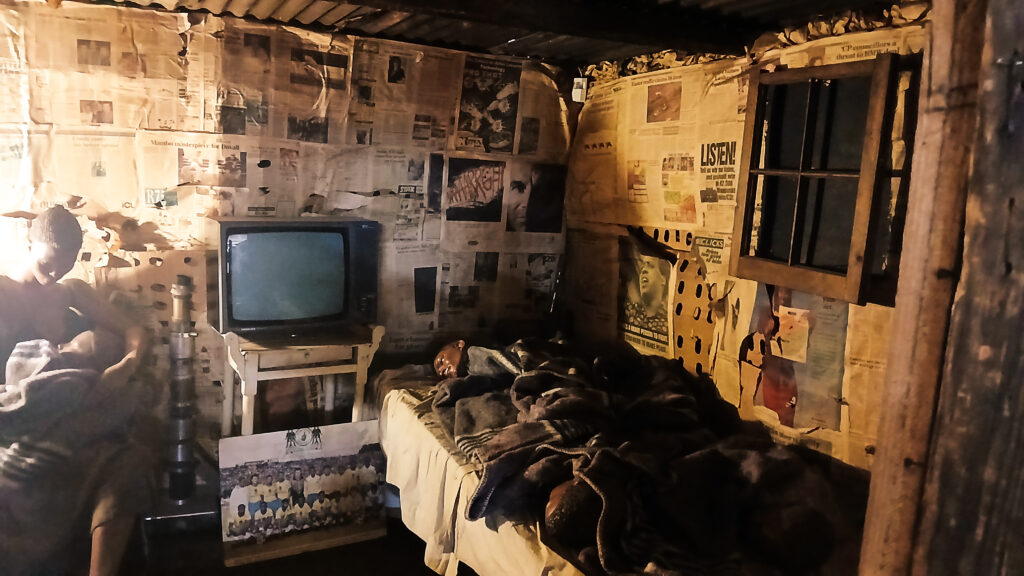
I came to Alexandra hoping to find artists, thinkers, and cultural figures. Instead, I was directed to taverns—spaces thick with alcohol, Maskandi music, and heat. The soundtrack of unmistakably Alexandra is Maskandi, Amapiano, Afropop. At one point, Brenda Fassie’s voice poured out of a shack—raw, defiant, while people shouted inside and a man stepped out holding an open beer.
What struck me most were the children. I have never seen so many children in one place. They filled the streets—laughing, shouting, playing football in sewage, dressed in light shorts and thin shirts, moving in packs. There was no visible depression. Only motion. Only life. Women crouched on pavements selling nuts, mangoes, avocados, and cooked corn. Men and older boys stood nearby smoking, drinking, and playing cards in worn jeans and flip-flops. Some urinated openly, adding to the already fermenting smell of the streets.
If I had to describe Alexandra in two words, I would say: instantly dehumanising. And yet, the question came back to me: why do people live here? The answer was immediate—don’t be a hypocrite.
There is no silence in Alexandra. Not the silence of peace, nor the silence of despair. Just constant noise—cars, radios, shouting, music, arguments, children, animals. It feels like a permanent state of uprising, except nothing is actually changing. The buildings—shacks and ageing flats look as though they were abandoned decades ago and simply never repaired. The dominant colour is a dusty red. Earth. Rust. Fatigue.
What stayed with me most is how the abnormal becomes normal. Is this resilience? Is this “making lemonade from lemons”? If it is, I struggle to believe anyone would willingly drink it. At one point, I asked a woman—her child tied to her back as she packed up her street stall: “Why do you live here?” She looked at me, almost confused. “This is my home.”
That is where the story ends, but also where it begins.
Comments are closed